-
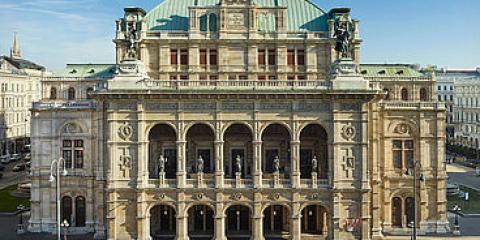
Ballet: Onegin State Opera Vienna - Wien Sun 29.Nov 2026 19:00 replace me !Ballet: Onegin State Opera Vienna - Wien Fri 04.Dec 2026 19:30 replace me !Ballet: Onegin State Opera Vienna - Wien Mon 07.Dec 2026 20:00 replace me !Ballet: Onegin State Opera Vienna - Wien Fri 11.Dec 2026 20:00 replace me !Ballet: Onegin State Opera Vienna - Wien Mon 14.Dec 2026 20:00 replace me !Ballet: Onegin State Opera Vienna - Wien Wed 16.Dec 2026 20:00 replace me !A restless dandy is too late to realise that a middle class woman is the love of his life. Letters are torn up. Lives are destroyed.
With his adaptation of Pushkin’s verse novel Eugene Onegin John Cranko created a masterpiece of narrative ballet and one of the most famous story ballets of the 20th century. Choreographer John Cranko presents the story of the ill-fated love between the young woman Tatyana and the anti-hero Onegin to a range of works by the composer Pyotr I. Tchaikovsky, though not his opera Eugene Onegin. It is as if he holds a magnifying glass up to the emotions and passions of his characters that become the motor of his dramaturgy, which is told exclusively through dance.
“Why did you visit us? In the backwoods of a forgotten village, I would have never known you nor have known bitter torment.” Ever since John Cranko’s Onegin was first performed by Stuttgart Ballet in 1965 Tatyana’s desperate letter appealing for Onegin’s love has been as familiar to connoisseurs of ballet as it is to lovers of literature. Cranko’s choreographic adaptation of Alexander Pushkin’s verse novel is one of the most famous narrative ballets of the 20th century as well as being one of the major works by this South African choreographer, whose grasp of ballet as an art form and directorial instinct for developing dancers and other artists was not only responsible for the “miracle of Stuttgart Ballet“, but whose work in the South West of Germany from the 1960s onwards represents one of the most important chapters in the history of German ballet.
The choreography switches between large ensemble scenes, intimate moments between the four main characters and emotional Pas de deux. Onegin is the definitive example of how Cranko interpreted narrative ballets and what he sought to achieve through them: “What he had in mind was”, according to Hartmut Regitz, “a new kind of full-length ballet: one that was marked out by the clarity of its story and the psychological portrayal of its characters and culminated in gigantic Pas de deux, whose wealth of emotion and radical choreography opened up dimensions of dance and a range of expression that had never been known before.”
John Cranko’s ballet Onegin is based – like the opera Eugene Onegin by Pyotr Ilyich Tchaikovsky – on the verse novel by Alexander Pushkin, but takes its own musical path. Instead of using music from the opera, the score was newly assembled from various works by Tchaikovsky and specially arranged for the ballet by Kurt-Heinz Stolze.
The focus lies on piano compositions, particularly the cycle The Seasons, Op. 37a, supplemented by excerpts from operas and symphonic works. Through the combination of short, flexibly deployable musical numbers, a dramaturgically cohesive form emerges, in which themes are developed and transformed in a leitmotivic manner. The instrumentation follows Tchaikovsky’s style but is deliberately more chamber-like in character, resulting in a transparent sound language that precisely supports the narrative while allowing major orchestral climaxes to stand out effectively.
A duel in 1837 proved fatal for the 38-year-old Alexander Pushkin – just as it does for Lensky in Onegin. John Cranko also did not live to an old age: he died in 1973 at the age of only 45, during the return flight from a U.S. tour.Order your tickets for the Vienna State Opera and book your tickets now at viennaticket.at.
(Source: wiener-staatsoper.at)