
Palais Auersperg
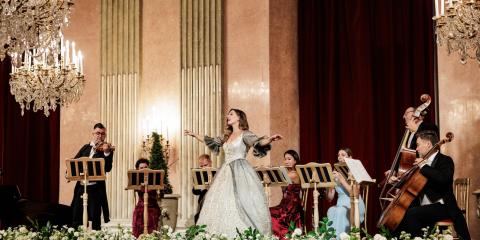
The Palais Auersperg was built between 1706 and 1710 according to the plans of the Baroque architects Johann Bernhard Fischer von Erlach and Lukas von Hildebrandt.
Since then, the Palais Auersperg has been a focal point of European musical, political, and social history: Wolfgang Amadeus Mozart, Joseph Haydn, and Christoph Willibald Gluck all contributed their pieces to world music here.
The noble families Rofrano, Kinsky, Saxe-Hildburghausen, Auersperg, and the Swedish royal House of Vasa conducted high politics at the Palais and created a manifestation of aristocratic splendor with opulent festivities.
Even during the dark days of World War II, the building next to the Vienna Hofburg played a pivotal role in history: in the Palais's extensive cellars, the resistance fighters of the O5 unit met, prevented the destruction of Vienna, and laid the foundation for a new, free Austria.
Since then, the Palais Auersperg has been a focal point of European musical, political, and social history: Wolfgang Amadeus Mozart, Joseph Haydn, and Christoph Willibald Gluck all contributed their pieces to world music here.
The noble families Rofrano, Kinsky, Saxe-Hildburghausen, Auersperg, and the Swedish royal House of Vasa conducted high politics at the Palais and created a manifestation of aristocratic splendor with opulent festivities.
Even during the dark days of World War II, the building next to the Vienna Hofburg played a pivotal role in history: in the Palais's extensive cellars, the resistance fighters of the O5 unit met, prevented the destruction of Vienna, and laid the foundation for a new, free Austria.